lauantai 6. syyskuuta 2014

1920 Tallinn Skyline


Read more about 1920 Tallinn Skyline here:
http://www.filateelia.ee/efur/catalogue/cat8.html
 
Day of Issue: May 4, 1920 Perforation: imperforate Issued: 4 939 000


25 p. green Jaan Lubi-forgeries exists; please, look at down*

Day of Issue: September 15, 1924 Perforation: imperforate Issued: 3 000 000
 

Tässä kirjatussa kirjeessä on arvoituksia...

Tästä kirjeestä ehkä ei ole näyttelykappeleeksi, mutta tämän arvoituksen ratkaisemiseksi tarvitaan roimasti tietoa. Kirjeestä käy ilmi, että toista Eestin Filatelistipäivää on vietetty 24.3.1935 ja paikkana on ollut Tallinnan ühisklubi, Pikk Tänav 42. Kuorella on hammas-tamaton kutojan 2 Mk merkki vuodelta 1922 (painettu 130 000 kpl). Sitten siellä on vuoden hammastamaton1924 Tallinnan silhuetin 25 p. nelilö ja invalidi-julkaisun ylipainama vuodelta 1920. Yhteisesti näistä merkeistä löytyy arvoa 5 Mk ja 15 sentiä. Käsikirjatarkastelussa käy ilmi, että juuri nämä markka-ajan kaikki merkit ovat poikkeuksellisesti voimassa vuoteen 1940, joten siltä osin asia on kunnossa. Mutta miten lasketaan onko postitaksa oikea? Se tiedetään, että kirje on aivan oikein kulkenut kirjattuna, koska takaa löytyy Tarton tuloleima 25.3.35. Täytyy jälleen kaivaa käsikirja esiin ja sieltä löytyy tieto, että kun raha- uudistuksessa (1.1.1928 alkaen) markkoja muutettiin krooneiksi, vaihtokurssina käytettiin "1 senti = 1 old marka". Hienoa, nyt ongelmat haihtuivat kauas pois. Vuoden 1928 leopardi merkki 15 s lisättynä 5 sentillä antaa tulokseksi 20 sentiä. Mattilan kirjasta näemme, että kirjaus tuohon aikaan maksoi 0,10 kr. ja 20 gr. kotimaan kirje myös 0, 10 kr. Huomattavaa on, että kotimaan postin osalta kirjemaksut eivät muuttuneet kertaakaan 1.1.1928-29.2.1940 välisenä aikana; ulkomaan kirjeiden osalta kylläkin.

25 p. yellow Jaan Lubi-forgeries exists; please, look at down*

Day of Issue: March 25, 1920 Perforation: imperforate Issued: 2 288 645


Kirje Tallinnan Tietäjän toimitukseen

Tämä on tavallinen kotimaan kirje "Tallinna Teatajä Toimetusele", lähtenyt Rakveresta 26.4.1920 ja saapunut Tallinnaan seuraavana päivänä 27.4. (leima takana läpässä). Postimaksuna on karmiininpunainen 2 x 35 p  Tallin Skyline. Täytyy ottaa Mattila esille ja katsoa, onko postimaksu oikein. Kirjassa sanotaan, että 15 gr. kirje kotimaahan ajalla 1.1.1920 - 30.6.1920 maksoi 70 p. Paikallisena kirjeenä maksu olisi ollut 35 p. "Paikallinen kirje"-järjestelmä lopetettiin 31.12.1923.

Huomioitavaa on, että Viron historiassa puhutaan kahdesta eri Tietäjä-lehdestä. Molempien lehtien syntyyn oli vahvasti vaikuttamassa Viron mahtimies Konstantin Päts. Ensimmäinen Tietäjä oli perustettu vuonna 1901 vastavoimaksi Jaan Tönissönin Postimies-lehdelle ja poliittiselle näkemykselle. Vuonna 1904 Päts valittiin Tallinnan kaupungin apulaiskaupungin-johtajaksi ja tämän saavutuksen katsottiin olleen Tietäjä-lehden ympärille ryhmittyneen poliittisesti aktiivisen joukon paras aikaansaannos. Siihen aikaan historiaa tehtiin kovassa turbulenssissa ja tämä Tietäjä-lehti jouduttiin lakkauttamaan. Samoihin aikoihin Konstantin Päts joutui itsekin todella kovaan rulettiin, joka johti hänet Pietarin Krestyn vankilaan (10. helmikuuta, 1910). Ihme ja kumma, että hän selvisi sieltä elävänä ulos.

Jatketaan englanniksi Wikipedian tekstillä: Päts was released on March 25, 1911 from the Kretsky Prison. The governor of the Governorate of Estonia complained about Päts' activity in Estonia in 1905 and pleaded for the government not to let him return to Estonia. Päts was then banned from living in the Governorates of Estonia and Livonia for six years. However, strong connections with Jaan Poska helped him return to Estonia, where he founded another newspaper, Tallinna Teatajä.

35 p. carmine rose Jaan Lubi-forgeries exists; please, look at down*

Day of Issue: September 17, 1920 Perforation: imperforate Issued: 2 898 600

Kotimaan kirje Rakveresta Tallinnaan 11.4.1922, postimerkkejä kirjeen takapuolella 10 Mk:n arvosta: kirjaaminen ajalle 10.4.1921-31.12.1923 = 5 mk, ja kotimaan 20 gr. kirje = 5 Mk.


Day of Issue: December 4, 1920 Perforation: imperforate Issued: 7 277 200

 
Herra johtaja A. Teetsov oli tuhannen toimen mies. Sen lisäksi hänellä oli yllättävän laaja kirjeenvaihto ympäri maailmaa. Tämä kirjattu kirje on lähtenyt Belgiaan ja yleensä Teetsovin kirjeissä on oikea taksa. Ulkomaan kirjattu kirje ajalla 1.7.1920-9.4.1921 oli 2 Mk 50 p ja kirjaus samalle ajalle toiset 2 Mk 50 p, joten nytkin summa on oikea. 10.4.1921 hinnat kipaisivat ylöspäin oikein reippaasti eli 4-kertaisiksi, kertoen että Mr. Inflaatio oli voimakkaasti astunut mukaan kuvioihin.

1 Mk brick red Jaan Lubi-forgeries exists; please, look at down*

Day of Issue: August 5, 1920 Perforation: imperforate Issued: 1 874 600
missing...

2 Mk ultramarine Jaan Lubi-forgeries exists; please, look at down*


Day of Issue: November 25, 1920 Perforation: imperforate Issued: 6 622 700
 
A pair of 2 Mk blue on the front and some other stamps on the back: all together 5 Mk 10p. That is 10 penni too much.

2 Mk blue Jaan Lubi-forgeries exists; please, look at down*


Day of Issue: June 10, 1920 Perforation: imperforate Issued: 4 924 000


Tämä kirjattu Kreopas-kirje on lähtenyt Tallinnasta ulkomaille Suomen Haapajärvelle 15.8.1921, saapunut Helsinkiin 16.VIII.1921 ja kolme päivää myöhemmin Haapajärvelle 18.VIII.1921. Postimerkkeinä ovat 8 x 2,50 Mk blue skylines = 20 Mk. Taksa on oikein, sillä kirjaus ajalle 10.4.1921-31.10.1922 oli 10 Mk ja postimaksu 20 g. kirjeelle oli myös 10 Mk.

Missä on Aegviidu? 
 Aegviidu on kylä pohjois-Virossa. Aegviidu on mainittu ensimmäistä kertaa vuonna 1796. Vuonna 1870 sinne avattiin rautatieasema (Tallinna-Pietarin rata). 1920 luvun alussa Aegviidu sai  postitoimiston, apteekin ja kaupan.


Sisemaaline postkaart eli kotimaan postikortti osoitteeseen Lisette Oll, Aegviidun asema. Ajalla 10.4.1921 - 31.12.1923 tuollaisen postikortin lähettäminen maksoi 2 Mk 50 p. ja kortilla postimerkin arvo on oikein.

2, 50 Mk blue Jaan Lubi-forgeries exists; please, look at down*

Jaan Lubi forgeries of 1920 Tallinn Skyline

25 p. green and yellow forgeries, A, B,C and D


35 p.  carmine rose forgeries, A, B,C and D

1 Mk brick red forgeries, A, B,C and D


2 Mk blue forgeries, A, B,C and D


Ostin vuonna 2013 100 kpl erän Tallinnan Silhuetin "postimerkkejä". Todellisuus oli se, että yksikään ei ollut postimerkki vaan joka ikinen oli väärennös.

2,50 Mk blue forgeries, A, B,C and D


Literature: Erik Sjögren 1983: Distinguishing features of Jaan Lubí forgeries of Estonian stamps, Eesti Filatelist No. 29.

tiistai 2. syyskuuta 2014

1919 Viking Ship


Did you know this about company APOLLINARIS-BRUNNEN from Bad Neuenahr?

This is the registered letter from Tallinn (23.10.1922) to the mineral water company Apollinaris-Brunnen in Bad Neuenahr, Germany. The letter is arrival-stamped in Neuenahr 27.10.1922. The spring (brunnen) was discovered in 1852 in the vineyard of George Kreuzberg, who named it after St. Apollinaris of Ravenna. From the very beginning the water of the spring was advertized to contain healing powers. For the matter to be completely true, there are testimonials by medicine doctors, mostly from Germany but also from foreign lands. Still today, the Apollinaris brand is going strong. When you look at those Viking Ship stamps of 1 Mk and 5 Mk, they are both printed on white paper. These stamps on cover are more rare than stamps printed on grey paper. Why? Please, look at how many stamps are issued each of them.


The total value of the stamps on this cover is 21 Mk. However, during 10.4.1921 - 31.10.1922 the registered foreign letter of 20 gr. was 20 Mk (the registration was 10 Mk and the postal fee 10 Mk). So, why 1 Mk too much? Well, that is a riddle but how about speculating with the printed remark "Postkastist Väljavõetud" ( taken out of the inbox). When we look at the reverse side of the envelope, we notify the above mentioned stamped statement with word Ametnik (official) and date 22/X + initials. This stamped statement means; out of ordinary routine action taken. The Ametnik, (official) has received the envelope 22/X (maybe from the postman?) with remark "einschreiben", (registration) and clearly the statement is same handwriting as is all the receiver information. Then the Ametnik does all the registration routines and all is then done as asked. Eventually the original sender of the letter was not in the post office present himself but maybe sitting faraway, in the office of some company (sender not mentioned). The question is: is it possible that in some cases the "Postkastist Väljavõetud"- service was payable?


Day of issue: July 28, 1919. Imperforate. Issued: 986 800 
 
Sotasensuuria vuoden 1919 Suomessa

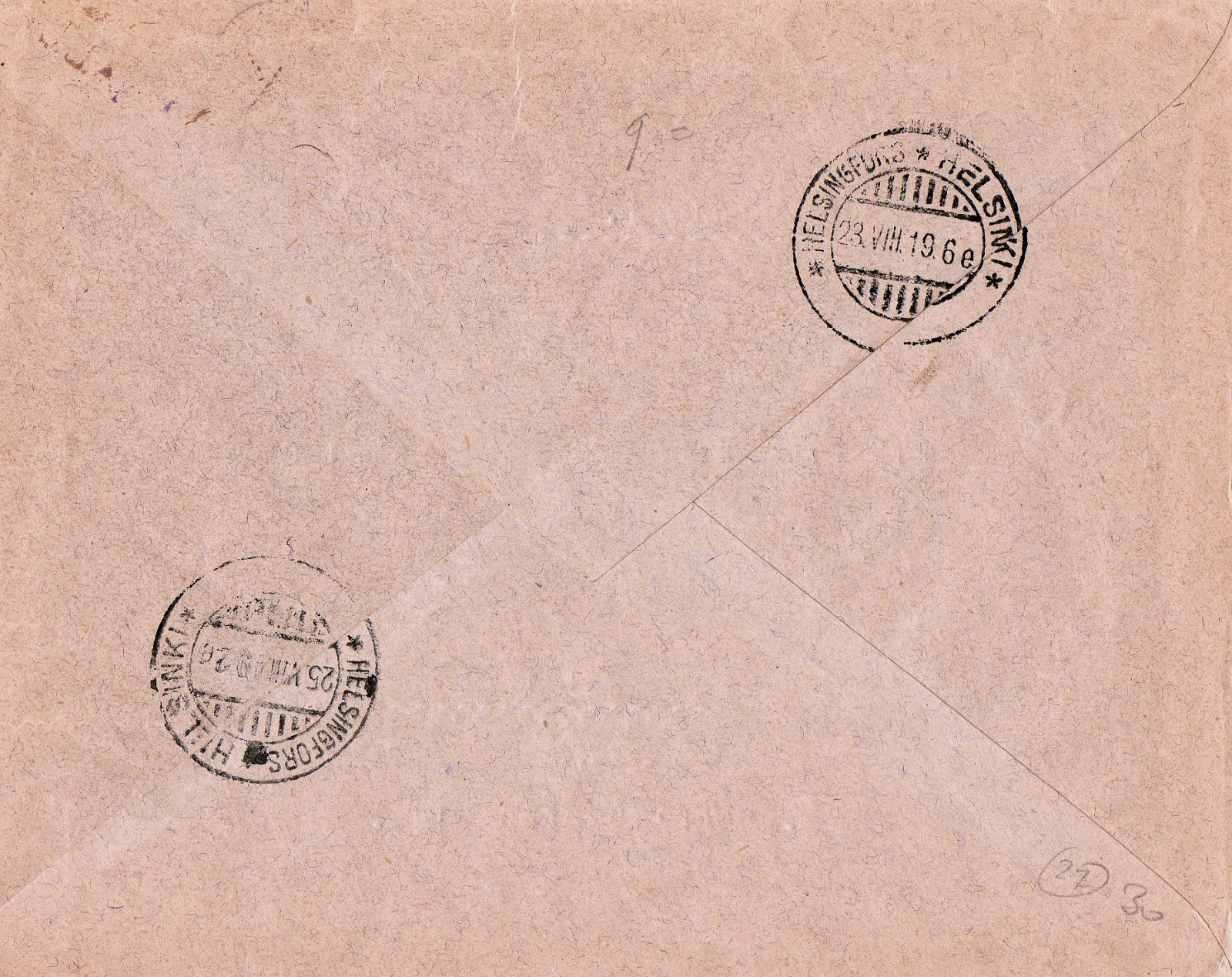
Tämä yllä oleva kirjattu kirje on lähtenyt Virosta 21.8.1919 ja kirje on osoitettu Suomeen. Kuten näkyy, kirje on "Tarkastettu Suomessa" sotasensuurin toimesta. Kirje on leimattu "alustavasti saapuneeksi" Helsinkiin 23.VIII. 1919.6e ja "lopullisesti saapuneeksi" 25.VIII. 1919.2e. Myöhempi leima kertoo, että kirje viipyi sotasensuurissa 2 päivää. 

Tässä kirjeessä ainoana merkkinä on 1 Mk sininen Viikinkilaiva, joka on vuorenvarmasti painettu valkoiselle paperille. Tämä kirje on melko varhaista sinisen Viikingin käyttöaikaa, lähettety vain 3 viikkoa merkin ilmestymisen jälkeen. Postitaksa on oikea; kirjaus 0,50 Mk ja 15 gr. ulkomaankirje 0,50 Mk = yhteensä 1 Mk.


T
Day of issue: March 3, 1920. Imperforate. Issued: 2 050 000


Day of issue: September 1, 1919. Imperforate. Issued: 525 000


Day of issue: August 2, 1920. Imperforate. Issued: 5 063 670
 
Kirjattu kirje Tartosta Berniin 21.9.1920 

Bern on Sveitsin pääkaupunki, saksankielinen ja asukasluvultaan maan viidenneksi suurin kaupunki. Kaupungissa on asukkaita noin 140 000. Bernin perusti vuonna 1191 herttua Berchtold V. Legenda kertoo, että herttua nimesi kaupungin ensimmäisellä metsästysretkellään kohtaamansa eläimen mukaan. Eläin sattui olemaan karhu (saks. Bär).

Postitaksa ulkomaan kirjeelle ajalle 1.7.1920 - 9.4.1921:

kirjaus 2 Mk 50 p. ja kirje ulkomaille (15 gr.) 2 Mk 50 p = 5 Mk, eli kelta/musta viikinki kirjeellä on oikein. Kirjeen takana on tuloleima: Bern 1.X.20. - 4, briefträger.


Inverted center error stamps are of course rarities because that is the major error in the production of the stamps. There are many forgeries about this inverted center 5 Mk Viking. 

The stamp above is genuine and its trade mark is: OFF CENTERED. The length of the black frame (outside measure) is 29.50 mm. Source: Pertti Hujala

The length of the black frame below is 30.23 mm. That is a forgery, printed on quite white paper and it is "too well centered". There are many other forgeries about this inverted center Viking 5 Mk. The white paper forgeries eventually belong to the early production. If you are not careful, you will be deceived easily with this quality forgery.


Day of issue: September 2, 1920. Imperforate. Issued: 634 550


Kasvatuksellisia tavoitteita leimoissa... 
Tämä hammastamattomalla 15 Mk vihreällä Viikingillä varustettu, Suomeen pintapostina tarkoitettu kirje on leimattu Tallinnan K16-rullaleimakoneella 19.11.1923. Leimaan on liitetty kasvattava ja tiedottava iskulause: "igal kirjal olgu täielik saatja ja saatja address" eli "joka kirjeessä olkoon täydellinen lähettäjän nimi ja osoite". 


Postitaksa ulkomaille menevälle kirjeelle (20 gr.) ajalle 1.11.1922-31.12.1923 oli 15 Mk, joten taksa tässä kirjeessä on oikein. Helsingin pyöreä tuloleima takana ilmoittaa, että kirje on tullut perille 21.XI.1923.

Joskus kuule, että Suomella ja Virolla oli erityisjärjestely postitaksojen osalta aivan alusta alkaen, joten ei "niitä taksoja voi katsoa ulkomaan sarakkeista". Aivan oikein sanottu, mutta erityisasema astui voimaan vasta 31.12.1928 (ja päättyi 30.11.1940). Ennen 1.1.1929 Suomi oli virolaiselle postille aivan tavallinen ulkomaa.

Sitten hieman lisää valistavista leimoista: alla kopio käsikirjasta liittyen kyseiseen aiheeseen. "Postimerkit pantakoon lähetyksen oikeanpuoleiseen kulmaan", sanotaan leimatyypissä numero 228 vuodelta 1923/25. Numero 227 oli käytössä vuosina 1922/25. Ylläolevan kirjeen rullaleima ei ole kumpikaan alla kuvatuista, koska siinä teksti on numerosta 227 ja leimaosa numerosta 228 (palkit puuttuvat).


Day of issue: June 8, 1922. Perforation: 14x13½. Issued: 2 394 050

Let us go further. Down we have a foreign letter from Tallinn to Berlin, and it departed from Tallinn on October 14, 1924. It arrived in Berlin W 30, 17.10.1924 reads on the back of the envelope. The postal fee of 20gr. foreign letter for the period of 1.1.1924-31.1.1925 was still 15 Mk.

Now, please, remember: this letter is quite beautiful with only one 15 Mk Viking stamp. However, the imperforated 15 Mk Viking on the letter before is 5 times rarer that this one below! Next time when you see 15 Mk Viking on the letter, please, observe if the stamp is imperforated or perforated.
  This is very exciting letter to Chicago

This registered foreign letter is addressed to Mr. Adolph Sonntag, 110, Franklin Street, Chicago, Illinois, USA. The sender is Richard Adler, his title is Postal Official, Rakvere, Estonia, Europe. The Letter departed Rakvere 3.XI.1924 and it arrived in Chicago November 21, 1924. We can find out stamps together of value 30 Mk. That is correct; fee of 20 gr. foreign letter was 15 Mk and registration 15 Mk. The riddle is the 1924 Final Air Mail issue yellow-black 5 Mk Sablatning P III with landing wheels; why is it on the envelope? The Air Mail fee to America between 23.7.1923-31.12.1927 was 40 Mk, not 5 Mk. What was in the mind of postal official Richard Adler when he fixed this Air Mail stamp on the envelope? We can guess his thinking going like this:

Dear gentlemen of the future,  I think this way: "I know the Air Mail fee to America is 40 Mk. However, the point is that after the year 2000 this envelope will be a great rarity in the world. All the handbooks and experts will say that is not possible, not recorded. However, I made it happen: a single, unperforated 5 Mk Yellow-Black Sablanting P III stamped with the original Rakvere cancellation! Can you deny it? This is a genuine letter with genuine stamps, genuinely cancelled and genuinely traveled; not necessarily by air but anyway by water. And traveling over water for me is almost same as in the air." (This is not the only this kind of envelope Mr. Adler made).

Day of issue: September 2, 1920. Perforation: imperforate. Issued: 401 850

missing item
 

Day of issue: June 8, 1922. Perforation: 14x13½. Issued: 627 150
Registration between 1.11.1922-31.1.1925 was 15 Mk. The fee of the 20 gr.foreign letter for period 1.11.1922-31.12.1923 was also 15 Mk. So, the total of 30 Mk is correct. The letter departed Tallinn on August 30, 1923 and arrived in Mulhouse on September 4. 1923.


 25 Mk Forgery
source: Pertti Hujala


Printing plate for the 25 Mk forgery was type 1x4 (source: Pertti Hujala)


will continue later on...

vvv
vvv

perjantai 1. elokuuta 2014

Sun Design 1919

This above is genuine, mint 4-block of Sun Design 1919

Read more about Sun Design here: 
http://www.filateelia.ee/efur/catalogue/cat6.html


This above is a genuine Sun Design stamp. A very thin "cigarette paper" was used when printing the Sun-design stamps. Later on the Tallinn Skyline stamps were printed also on the similar, very thin paper.

The next four items are:


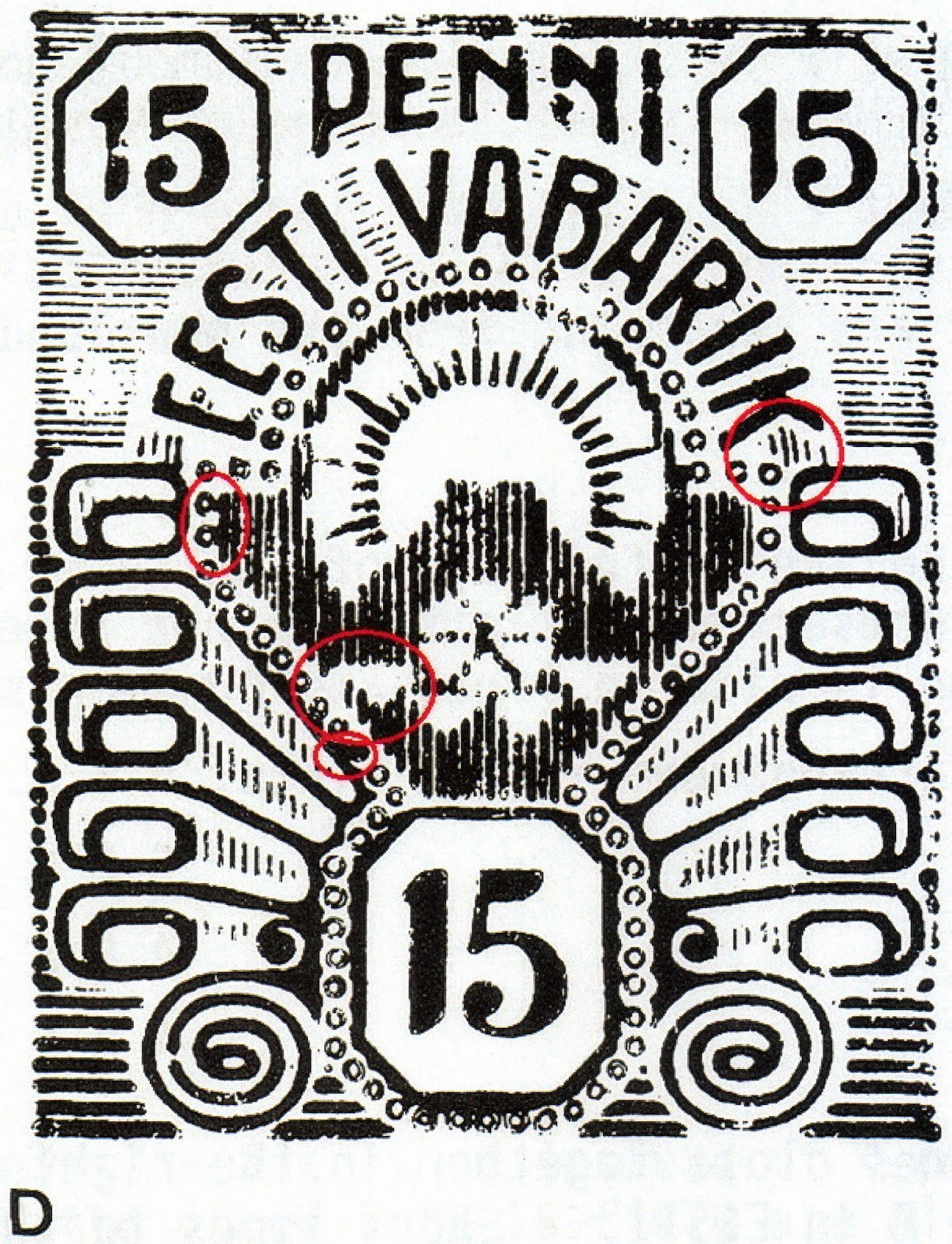
These are very easy to detect; just focus to the middle sections and you will see easily the differences with genuine printings. And remember, there are only these 4 different types which Jaan Lubi used in his forgery-work.
                                                  False A


                                                         False B

 
                                                         False C

                                                          False D